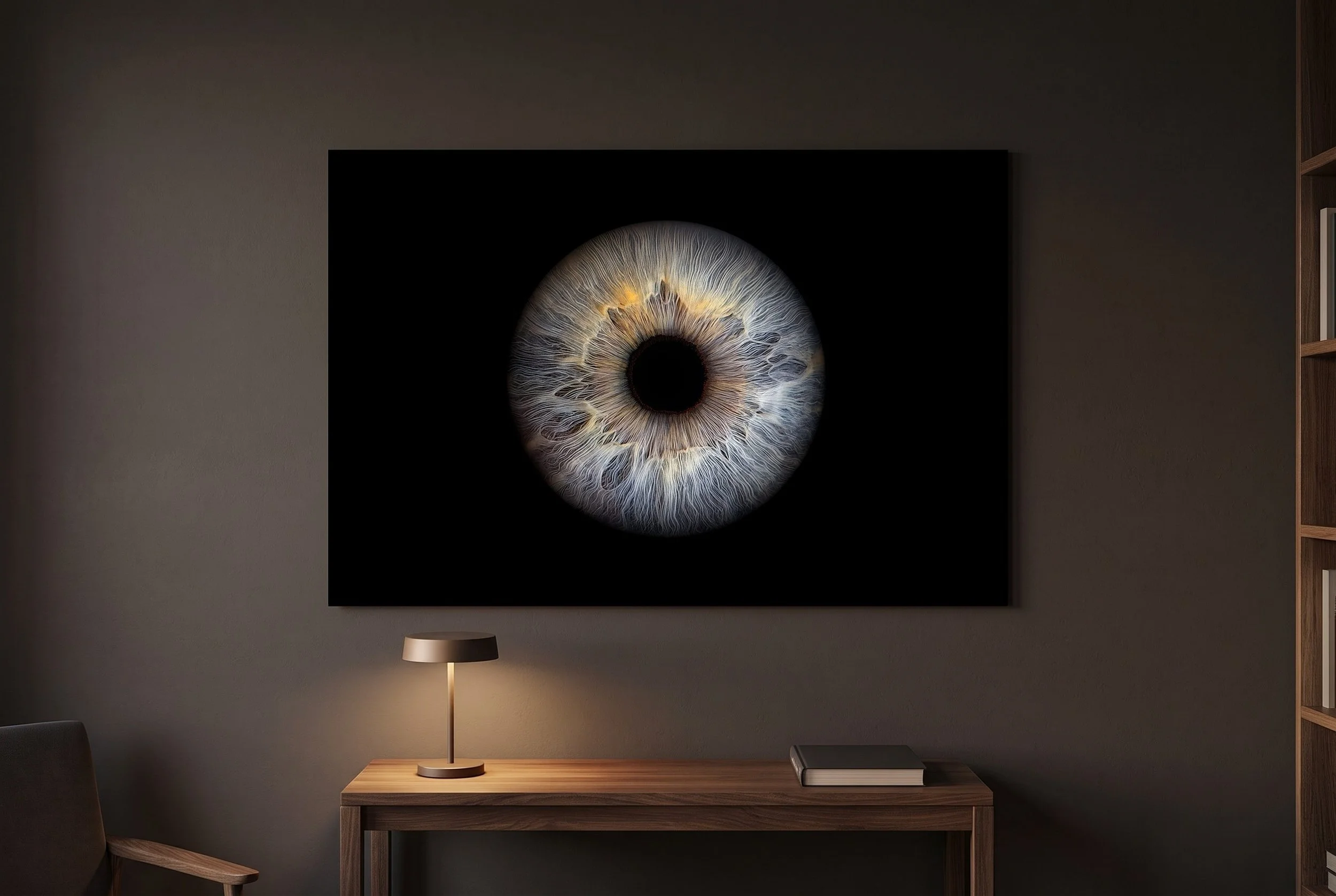
In a mirror, your iris is a color. That is really all you get: a color, and a black dot in the middle of it.
Under the macro lens in the studio, that same iris is a landscape. It has a center that is not solid, a ruffled ring, fibers running out like spokes, bands of pigment laid down in layers, little dark valleys, and a dark frame around the whole thing. Every one of those parts is in your eye right now. You have just never been close enough to see them
This is one iris, walked part by part, from the center out.
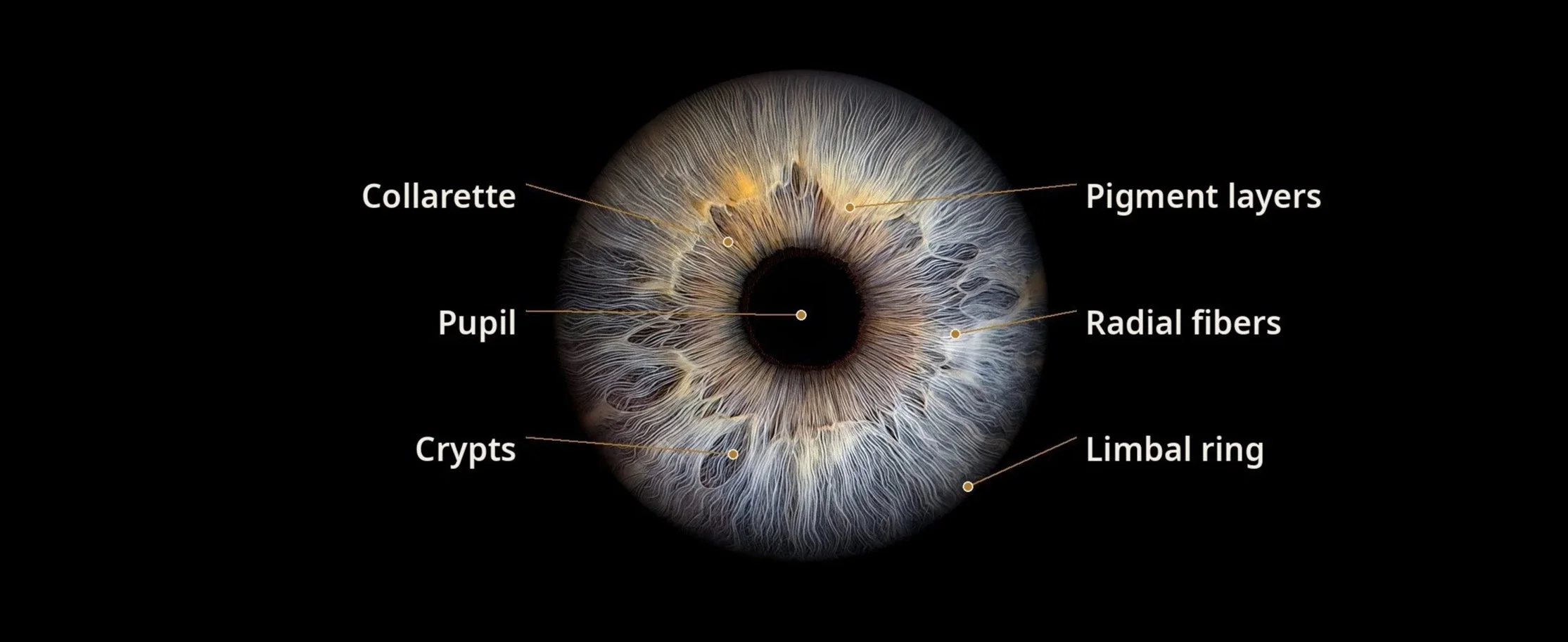
The pupil is not a thing. It is an opening.
Start in the middle. The black circle you call the pupil is not a part of the eye at all. It is an opening, the opening the iris leaves in its own center, and the darkness you see is the inside of the eye behind it.
The iris is the muscle that works that opening. It widens it in the dark and closes it down in bright light, all day, without asking you. That is why the pupil sits a touch different from one frame to the next during a session. It is alive and reacting, including to our flashes. We fire the strobes more than once partly for this: a settled, smaller pupil leaves more of the iris on show, and the iris is the whole point.
The collarette: the ruffled ring
Move out from the pupil and the first thing you meet is a ring that looks ruffled, almost like the edge of a pie crust. That is the collarette.
It is the thickest part of the iris, and it is the dividing line between the inner zone around the pupil and the outer zone that runs to the edge. In a lot of eyes it is also where the color shifts: one tone inside the ring, another outside it. When people tell me their eyes cannot decide what color they are, this ring is usually the reason. Two zones, two answers.
The radial fibers: spokes with a job
Past the collarette, the iris is strands. Hundreds of fine fibers run outward from the center like the spokes of a wheel, and they are not decoration. They are the structure of the muscle itself, the machinery that opens and closes the pupil.
Their pattern is set before you are born, and it does not repeat. Not in your other eye, not in anyone else's. Up close, no two stretches of fiber run the same way: some lie flat and even, some bunch and cross, some twist off in their own direction. This is the part of the portrait people stare at the longest, because it is the part that could only be theirs.
The pigment layers: color in bands
The color of an iris is not painted on. It is laid down in layers, and under the lens you can see the bands: a ring of one depth of color giving way to another, sometimes several times before you reach the edge.
That layering is why an eye that reads as a single color across a room reads as several colors up close. Nothing about the eye changes. You are just finally near enough to see that the one color was always a stack of them.
The crypts: the dark valleys
Between the fibers there are small, dark openings, like valleys between ridges. Those are the crypts, places where the surface layer of the iris opens and the deeper layer shows through.
They are a big part of why a detailed capture rewards a long look. From any normal distance they are invisible. At this size they are the shadows in the landscape, the spots your eye keeps coming back to because there is more depth in them than the surface around them.
The limbal ring: the frame
The last part is the edge itself: a dark ring where the iris meets the white of the eye. That is the limbal ring, and nearly everyone has one, stronger in some eyes than others.
It is the frame of the whole structure. Every portrait we make sits on a black background, and I have come to think the background works because the eye already frames itself this way. We are just extending the edge it gave us.
No two, not even your two
That is one iris: an opening, a ruffled ring, a field of fibers, layers of pigment, dark valleys, and a dark frame. Every one of those parts differs from eye to eye, which is why no two irises match, and why your left and right eyes, photographed side by side, are plainly two different landscapes from the same person.
This is what a session here photographs, at full size, detail first. If you want to see what yours is made of, start with the gallery, and when you are ready, book a session.